



As the widespread use of AI begins to reshape work and everyday life, one trend is clear: creating advanced AI models has become an expensive business, with costs often in the tens of millions of dollars and a huge demand for computing power.
That may be about to change. A growing movement is seeking to "democratise" AI development. One of its leading figures is Professor Hongxia Yang, Executive Director of the PolyU Academy for Artificial Intelligence at the Hong Kong Polytechnic University. Croucher News recently spoke to Yang, who is also an Associate Dean (Global Engagement) of the Faculty of Computer and Mathematical Sciences, about her innovations and her vision of a more accessible AI.
"If you rely on centralisation, no collaboration happens; people just compete with each other."
With 15 years' experience in the high-tech industry in China and the United States - at Alibaba, ByteDance and IBM Watson - Yang has seen both the financial realities of AI development and the technologies that underpin it.
A firm believer in AI's potential benefits, she describes the current race to build ever larger models as a "rich people's game" - one dominated by a handful of very wealthy companies. While in industry, she helped to build large, centralised foundation models. In academia, she has set herself a different goal: to make AI development more decentralised and collaborative.
"If you rely on centralisation, no collaboration happens; people just compete with each other ... What we really want to enable is that everyone can really be involved in this development and can really benefit." She compares today's centralised AI labs to the early era of computing dominated by mainframes, in contrast to today when "every cell phone is a decentralised computer."
Yang explains the immense investment that goes into building frontier models on the scale of the latest GPT systems. In the current centralised development model, it can take millions of GPU hours to train a single large model. At that scale, she says, "only the super-hot unicorns have the access to build their own generative AI models."
She has proposed a new paradigm, which she calls Co-GenAI (collaborative generative AI), aiming to lower the barriers to developing GenAI and involve a broader number of players in the AI era. One strand of this work is the use of FP8, a low-precision numerical format that represents numbers with just 8 bits (compared with formats such as BF16, a common "workhorse" for training on modern chips). In Yang's work, FP8 allows training to run faster and with significantly less memory: she reports about 20% faster training over the existing solutions. For hospitals or universities with limited resources, that makes developing their own models a realistic prospect.
Another key strand is model fusion. Rather than training from scratch - which is extremely resource-intensive - Yang's team combines several existing, well-trained models. Recently, they fused four state-of-the-art reasoning models using around 160 GPU hours, compared with the one to two million GPU hours typically needed to train a comparable model from the beginning. On demanding reasoning benchmarks across 11 reasoning domains, she reports average success rates rising into the mid-80 per cent range, significantly surpassing the state-of-the-art centralised models. Furthermore, Professor Yang's team is the first to theoretically derive (work out) the Model Merging Scaling Law. This finding suggests that decentralised approaches to achieving AGI are also feasible, offering an alternative path beyond the paradigm of centralisation.
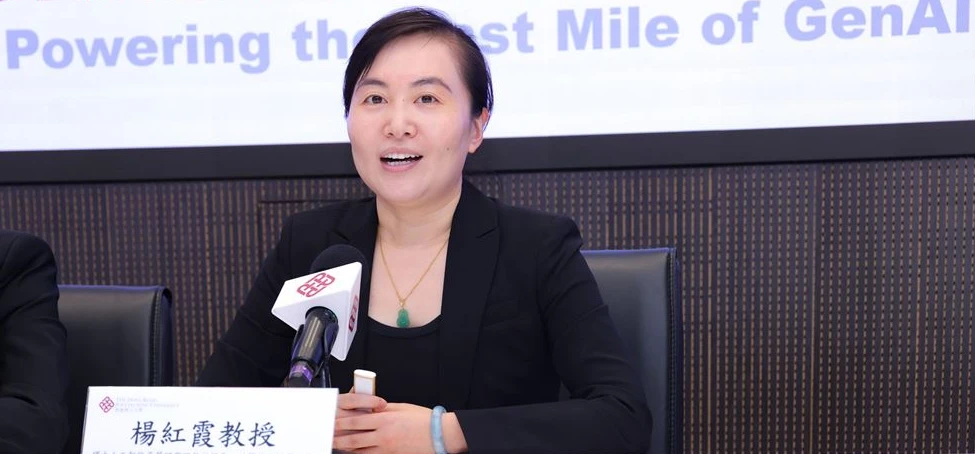
For Professor Hongxia Yang, the aim is practical: high-quality generative AI that more organisations can train, run and govern themselves.
Building on this, Yang is committed to advancing the real-world deployment of GenAI in vertical domains or specialised fields. For example, she is building a specialist model for medicine. Today's frontier models may have over a trillion parameters, but, she argues, "If you are working with a specific domain... small models are totally sufficient. You probably only need, like, a 7 billion or 13 billion model," she says, with which "you can probably beat GPT-5 in the healthcare domain."
A central reason is data. General models rely largely on text scraped from the public internet. Hospitals, banks or laboratories do not publish most of their detailed, high-quality data online. As a result, large general models lack the specialist knowledge and are more prone, in these domains, to hallucinations - confident but incorrect answers.
To address privacy issues while making use of this specialised data, Yang's approach allows institutions to train locally and share only their models, not their raw data. "We actually enable each hospital, with their own data, to train their own models, and their data just to keep it private. They never have to move their data out of their hospital." By fusing several such models, her team can create a stronger foundation model that benefits from knowledge across multiple centres without any patient records ever leaving its home institution.
The result for hospitals is better models trained on their own data, enriched by learning from similar institutions elsewhere. This should mean fewer hallucinations. Running models locally rather than in the cloud also brings much lower latency, in other words, faster responses. For overstretched doctors, she notes, waiting for a remote system to respond can be impractical; local models can respond in milliseconds. She stresses that the aim is to support, not replace, clinicians: "This solution itself will not replace the doctors. The final decision-maker is still the doctor."
Beyond individual domains such as cancer treatment, Yang is working towards a science foundation model built by merging many highly specialised models. She imagines contributions from top research teams - "Nobel prize level" in their domains - each adding a strong domain-specific model, which can then be fused into a larger system.
She believes that by combining "probably tens of domain-specific models", it will be possible to build a science foundation model covering these domains. Fused together, she argues, such models could be "best across all the domains" they include.
Yang is optimistic that AI can benefit humanity and believes it is likely to "revolutionise every business" in the coming years. At the same time, she argues for stronger regulation - focused not on the technology itself but on how people use it. "I don't think we should curse the technology itself, but we should penalise people who didn't make good use of the generative AI models."
She notes that other groups, including high-profile start-ups, are now pursuing similar decentralised approaches, and she sees this as a pivotal moment in AI's development. When asked whether she is trying to change the world, she laughs off the suggestion. "I think that's too big for me, but at least I try my best to realise what I believe is the correct direction."